
The short answer
In light of the Third Circuit’s recent decision in Buele Morocho v. Warden, the national immigration-bond map has changed again.
Eight federal appeals courts—the First, Second, Third, Sixth, Seventh, Ninth, Tenth, and Eleventh Circuits—now recognize that many immigrants who entered the United States without inspection, lived here, and were later arrested inside the country may ask an Immigration Judge for bond directly under Immigration and Nationality Act §236(a).
For a person who fits that fact pattern, a federal habeas corpus order should not be necessary merely to establish that the Immigration Judge has authority to consider bond in those eight circuits.
The Fifth and Eighth Circuits currently take the opposite position. The Fourth and D.C. Circuits have not issued controlling appellate decisions resolving this exact question.
That is the overview—not the final answer for every detained person. The place of the Immigration Court proceeding, the person’s manner and timing of entry, criminal history, removal history, and the legal authority ICE cites for detention can all change the analysis. For detained immigrants facing bond issues, an Arlington, VA immigration lawyer can help determine which rules apply to their circumstances.
What does “entered without inspection,” or EWI, mean?
“Entered without inspection,” commonly shortened to EWI, generally means that a person entered the United States without being inspected and admitted or paroled by an immigration officer at a port of entry.
The recent federal appeals-court cases do not create a bond right for every person who has ever entered without inspection. They generally involve a more specific group:
- The person entered without inspection.
- The person was not detained while attempting to enter at the border.
- The person later lived inside the United States.
- ICE arrested the person in the interior of the country—sometimes years after entry.
- The person was placed in regular removal proceedings under INA §240.
- No separate mandatory-detention provision controlled the case.
That distinction between a border apprehension and a later arrest inside the country is central to the current dispute.
Why does an arrest at the border differ from an arrest inside the United States?
Federal immigration law contains different detention provisions for different situations.
The government has argued that INA §235(b)(2)(A), codified at 8 U.S.C. §1225(b)(2)(A), requires detention without an Immigration Judge bond hearing for people who entered without inspection because they remain “applicants for admission.” The Board of Immigration Appeals adopted that interpretation in Matter of Yajure Hurtado.
The eight favorable federal circuits have rejected that position for the qualifying interior detainees before them. Those courts concluded that INA §236(a), codified at 8 U.S.C. §1226(a), governs people who were already living inside the country when ICE later arrested them. Section 236(a) allows an Immigration Judge to consider release on bond.
The Fifth and Eighth Circuits have accepted the government’s broader reading of §235(b)(2)(A). The result is a genuine split among the federal appeals courts—and dramatically different outcomes depending on which circuit’s law controls.
What did the Third Circuit change?
On August 28, 2026, the Third Circuit issued its precedential decision in Buele Morocho v. Warden, Philadelphia FDC. The court held that the two interior EWI detainees before it were detained under §236(a), not §235(b)(2)(A), and affirmed the habeas relief they had obtained.
The decision matters throughout the Third Circuit: Delaware, New Jersey, Pennsylvania, and the U.S. Virgin Islands.
It also made the national alignment easier to see. The Third Circuit identified seven other federal circuits that had already rejected the government’s mandatory-detention theory—the First, Second, Sixth, Seventh, Ninth, Tenth, and Eleventh Circuits—and two that had accepted it—the Fifth and Eighth Circuits. By joining the first group, the Third Circuit became the eighth circuit recognizing §236(a) bond eligibility for similarly situated interior detainees.
The case involved two individual habeas petitioners; it was not a nationwide class action. Its statutory holding is binding precedent within the Third Circuit, but the judgment itself did not automatically schedule bond hearings for everyone detained there.
The decision is controlling law now. It may still be the subject of rehearing or a request for Supreme Court review, so its status should be checked before anyone relies on it in a new case.
The current federal circuit map
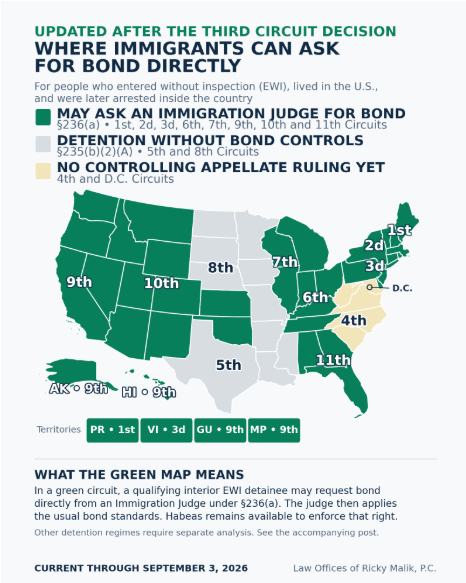
Circuits recognizing a direct §236(a) bond request
In these circuits, a qualifying interior EWI detainee should be able to request a bond hearing directly from an Immigration Judge. A federal habeas order should not be necessary solely to establish the Immigration Judge’s bond authority.
| Circuit | States and territories | Controlling appellate case |
| First | ME, MA, NH, PR, RI | Guerrero Orellana v. Moniz |
| Second | CT, NY, VT | Barbosa da Cunha v. Freden |
| Third | DE, NJ, PA, VI | Buele Morocho v. Warden, Philadelphia FDC |
| Sixth | KY, MI, OH, TN | Lopez-Campos v. Raycraft |
| Seventh | IL, IN, WI | Cirrus Rojas v. Olson |
| Ninth | AK, AZ, CA, HI, ID, MT, NV, OR, WA, GU, MP | Rodriguez Vazquez v. Bostock |
| Tenth | CO, KS, NM, OK, UT, WY | Santillan Quiroz v. Mullin |
| Eleventh | AL, FL, GA | Hernandez Alvarez v. Warden, FDC Miami |
Some of these cases arose from class actions and others from individual habeas petitions. That difference affects who can enforce an existing judgment directly, but it does not ordinarily shrink the geographic reach of a published federal appellate holding. For example, the Ninth Circuit case involved a class at the Northwest ICE Processing Center in Tacoma, but its published interpretation of §236(a) is precedential throughout the Ninth Circuit, including California and Arizona.
Circuits where controlling law currently forecloses the same direct request
| Circuit | States | Controlling appellate case |
| Fifth | LA, MS, TX | Buenrostro-Mendez v. Bondi |
| Eighth | AR, IA, MN, MO, NE, ND, SD | Avila v. Bondi |
These courts concluded that §235(b)(2)(A) requires detention without an Immigration Judge bond hearing for the similarly situated EWI detainees before them.
Describing these states simply as places where “habeas is required” would be misleading. A habeas petition does not automatically overcome controlling circuit precedent or guarantee a bond hearing. Habeas may still be available for a different statutory or constitutional challenge, including some claims involving prolonged detention, but that requires a case-specific analysis.
Circuits without a controlling appellate decision on this question
| Circuit | States or district | Current status |
| Fourth | MD, NC, SC, VA, WV | No controlling circuit decision yet |
| D.C. | DC | No controlling circuit decision yet |
The Fourth Circuit heard argument in Lopez Garcia v. Guadian on May 5, 2026, but had not issued a merits decision as of this article’s review date.
Individual federal district judges in the Fourth Circuit have granted relief. For example, on August 18, 2026, the U.S. District Court for the Eastern District of Virginia granted habeas relief in Espinosa Tranquilino v. Blanche, No. 1:26-cv-2603, and ordered the government to provide an Immigration Judge bond hearing under §236(a). That decision was important for the individual petitioner and may be persuasive in similar cases, but a district-court order does not bind every Immigration Judge or federal judge throughout the Fourth Circuit.
Until the Fourth Circuit rules, outcomes may vary by district, judge, and case posture. In Virginia, Maryland, North Carolina, South Carolina, and West Virginia, habeas can therefore remain especially important when the agency denies Immigration Judge bond authority.
Does a favorable circuit mean habeas is no longer useful?
No. The favorable circuit cases answer one major question: Does the Immigration Judge have statutory authority under §236(a) to consider bond for a qualifying interior EWI detainee?
They do not eliminate habeas corpus.
Habeas is a federal court action used to challenge unlawful detention. Even in a favorable circuit, it may still be necessary when:
- ICE or the Immigration Judge refuses to apply controlling circuit law;
- the government does not provide a hearing promptly;
- detention has become unreasonably prolonged;
- the legal dispute involves due process or another constitutional issue;
- the agency relies on a different detention statute; or
- immediate federal court intervention is needed to preserve meaningful relief.
The careful way to state the current rule is this:
Eight circuits recognize direct Immigration Judge bond authority for qualifying interior EWI detainees. Habeas remains an enforcement tool and may also address different detention claims.
Does the state where ICE holds the person determine which circuit’s law applies?
Not always. This is one of the most confusing—and practically important—parts of a detention case.
The removal case and the bond case are legally separate proceedings. A removal case generally begins when the Department of Homeland Security files a Notice to Appear, or NTA, with an Immigration Court. The location of that court—and any later change of venue granted by an Immigration Judge—generally determines which circuit’s law governs the removal proceeding.
A detained person’s initial bond request, however, ordinarily goes to the Immigration Court with jurisdiction over the place of detention. ICE transfers can therefore affect which Immigration Court hears the bond request even when the NTA was filed somewhere else.
That means neither the location where the person was arrested, the address printed on the NTA, nor the current detention center should be considered in isolation. Counsel should confirm:
- where DHS filed the NTA;
- which Immigration Court currently has the removal case;
- whether an Immigration Judge granted a change of venue;
- which Immigration Court has jurisdiction over the bond proceeding;
- where the person is physically detained now;
- whether ICE transferred the person between circuits; and
- where a federal habeas petition, if needed, must be filed against the proper custodian.
When circuits follow opposite rules, a transfer or venue issue can have major consequences. The case file—not an assumption based on geography—should determine the answer.
Who may fall outside these favorable EWI decisions?
Even in one of the eight favorable circuits, a person may be detained under a different rule. Separate legal analysis is especially important for:
People detained at or near the border
The recent favorable decisions generally concern people arrested in the interior after living in the United States. They should not be read as automatically extending to someone detained while seeking entry or immediately after crossing the border.
Arriving aliens
Immigration Judges generally lack bond authority over people legally classified as arriving aliens, although DHS may have separate parole authority.
Expedited removal
A person placed in expedited removal under §235(b)(1) is in a different process with different detention and review rules.
Mandatory detention under §236(c)
Certain criminal convictions, admissions, or security-related grounds may trigger mandatory detention under INA §236(c). If §236(c) applies, the favorable EWI circuit cases do not by themselves create ordinary Immigration Judge bond authority.
Laken Riley Act detention
The Laken Riley Act expanded mandatory immigration detention for certain alleged conduct and offenses. A person covered by those provisions needs a separate analysis; the interior-EWI decisions do not override an independent detention mandate.
Final removal orders
After a removal order becomes administratively final, detention may be governed by INA §241, codified at 8 U.S.C. §1231, rather than §236(a).
Reinstatement and withholding-only proceedings
A person whose prior removal order has been reinstated may be placed in withholding-only proceedings. The detention framework in those cases is different and may depend on the procedural stage.
Other unusual procedural histories
Prior parole, an old removal order, a claimed reentry, a pending review petition, or a special statutory designation can materially alter the answer. The label “EWI” is only the start of the analysis.
What does an Immigration Judge decide at a bond hearing?
Winning the right to ask for bond is not the same as winning release.
At a bond hearing, the Immigration Judge generally considers whether the person poses a danger to people or property and whether the person is likely to appear for future immigration hearings. Depending on the jurisdiction and the claim being litigated, the allocation of the burden of proof may also be disputed.
Evidence commonly presented includes:
- family relationships and caregiving responsibilities;
- length of residence in the United States;
- a stable address and proposed release plan;
- employment history;
- community and religious involvement;
- prior attendance at court and immigration appointments;
- criminal records and evidence of rehabilitation;
- immigration history;
- eligibility for relief from removal; and
- letters and documents showing that the person has a reason to return to court.
An Immigration Judge may deny bond or set a bond amount that the family considers too high. The circuit decisions discussed here restore access to the bond process for qualifying people; they do not promise a particular result.
What should a family do after an ICE arrest?
The first hours and days matter, especially because ICE may transfer a detainee quickly.
Families should try to collect:
- The person’s full name, date of birth, country of birth, and A-number.
- The exact detention location and any transfer history.
- The NTA and every custody or charging document provided by ICE.
- Information about any prior immigration court case, removal order, or border encounter.
- Complete criminal records—not only a family member’s recollection of the outcome.
- Proof of family ties, residence, employment, medical needs, and community support.
- Information about upcoming Immigration Court dates and the court currently assigned to the case.
An immigration detention lawyer can then identify the governing detention statute, determine which circuit’s law applies, request Immigration Judge bond when available, and assess whether federal habeas litigation is necessary.
Frequently asked questions
Can someone who crossed the border years ago and was later arrested by ICE ask for bond?
Often, yes—but the answer depends on the circuit and on whether another detention provision applies. In eight circuits, qualifying people arrested inside the United States after an earlier EWI may request Immigration Judge bond under §236(a). The Fifth and Eighth Circuits currently follow the opposite statutory rule, while the Fourth and D.C. Circuits remain unresolved at the appellate level.
What is habeas corpus in an immigration detention case?
A habeas corpus petition is a lawsuit in federal district court challenging the legality of a person’s detention. It is separate from the removal case. A habeas judge generally decides a detention question, not whether the person ultimately qualifies to remain in the United States.
Must a person in California file habeas before asking an Immigration Judge for bond?
For a qualifying interior EWI detainee, Ninth Circuit precedent in Rodriguez Vazquez v. Bostock recognizes detention under §236(a), so a prior habeas order should not be required merely to establish the Immigration Judge’s bond authority. Separate detention grounds or an agency refusal to follow the decision may still make habeas necessary.
What states are covered by the new Third Circuit decision?
The Third Circuit covers Delaware, New Jersey, Pennsylvania, and the U.S. Virgin Islands. Its precedential ruling recognizes §236(a) bond eligibility for qualifying interior EWI detainees.
Does the Third Circuit decision apply nationwide?
No. A federal circuit decision binds courts within that circuit. It may persuade other courts, but it does not create a nationwide rule. The Supreme Court could eventually resolve the disagreement among the circuits.
If the person is detained in Texas, can a habeas petition obtain an ordinary bond hearing anyway?
Not automatically. The Fifth Circuit’s controlling decision accepts the government’s §235(b)(2)(A) interpretation for similarly situated detainees. A different habeas claim—such as a properly supported constitutional challenge to prolonged detention—requires separate analysis and is not guaranteed to produce an ordinary §236(a) bond hearing.
Does a criminal charge or conviction always prevent bond?
No single answer applies. Some criminal grounds can trigger mandatory detention under §236(c) or the Laken Riley Act; other records may be considered as evidence of danger without eliminating bond jurisdiction. The exact statute, offense, disposition, sentence, and immigration history must be reviewed.
Does an ICE transfer change the law that applies?
It can affect which Immigration Court hears the bond request and where a habeas petition must be filed. Because the removal proceeding and bond proceeding are separate, counsel should confirm the NTA filing, current court venue, detention location, and transfer history before deciding which circuit’s precedent controls each issue.
Can this circuit map change?
Yes. The government may request rehearing or Supreme Court review in favorable cases, and other appeals remain pending. Supreme Court petitions involving the Second, Fifth, and Sixth Circuit decisions were pending as of September 3, 2026. Anyone preparing a bond request or habeas petition should verify that the cited decision remains controlling.
The practical takeaway
The law has moved quickly. Eight federal circuits now recognize that many people who entered without inspection, established lives inside the United States, and were later arrested here are detained under §236(a) and may ask an Immigration Judge for bond directly.
But “entered without inspection” does not answer every detention question. The person’s location, Immigration Court, transfer history, criminal record, prior removal history, and current type of proceedings all matter.
If ICE has detained a family member, the safest first question is not simply, “Can we file for bond?” It is:
What law authorizes this person’s detention, and which court has the power to review it now?
That answer determines whether the next step is a direct Immigration Judge bond request, a federal habeas petition, both, or a different legal strategy. If a family member has been detained by ICE, The Law Offices of Ricky Malik, P.C. can help assess the detention and determine what legal options may be available.
About the author
Ricky Malik has practiced U.S. immigration law for more than 24 years. He represents clients in removal defense, immigration detention, bond, and federal habeas matters through the Law Offices of Ricky Malik, P.C.
Primary legal sources
- Third Circuit — Buele Morocho v. Warden, Philadelphia FDC
- First Circuit — Guerrero Orellana v. Moniz
- Second Circuit — Barbosa da Cunha v. Freden
- Sixth Circuit — Lopez-Campos v. Raycraft
- Seventh Circuit — Cirrus Rojas v. Olson
- Ninth Circuit — Rodriguez Vazquez v. Bostock
- Tenth Circuit — Santillan Quiroz v. Mullin
- Eleventh Circuit — Hernandez Alvarez v. Warden, FDC Miami
- Fifth Circuit — Buenrostro-Mendez v. Bondi
- Eighth Circuit — Avila v. Bondi
- Fourth Circuit docket — Lopez Garcia v. Guadian
- BIA — Matter of Yajure Hurtado
- BIA — Matter of Garcia
- 8 U.S.C. §1225
- 8 U.S.C. §1226
- 8 U.S.C. §1231
- 8 C.F.R. §1003.19 — custody and bond proceedings
- 8 C.F.R. §1003.20 — venue
- Supreme Court docket 26-43 — Buenrostro-Mendez
- Supreme Court docket 26-104 — Barbosa da Cunha
- Supreme Court docket 25-1415 — Lopez-Campos
Legal disclaimer: This article provides general information and is not legal advice. Immigration detention law is fact-specific and changes rapidly. Reading this article does not create an attorney-client relationship. Consult qualified counsel about the facts and current law governing a particular case.