Arlington Family Based Immigration Lawyer
Trusted family-based immigration lawyers serving clients across Arlington, VA and the surrounding region for over 20 years.
If you are trying to bring a family member to the United States, or if a petition has stalled and you are not sure what comes next, the process carries significant stakes at every stage. Our Arlington, VA family based immigration lawyer at the Law Offices of Ricky Malik, P.C. has handled family petitions, adjustment of status cases, consular processing matters, and the complications that arise along the way for more than two decades. Contact us to schedule a consultation.
Family Based Immigration Lawyer Arlington, VA
Family-based immigration is the primary route through which most people become lawful permanent residents of the United States. U.S. citizens and lawful permanent residents can petition for qualifying family members, either as immediate relatives or through one of the family preference categories. After a petition is approved, the applicant must either adjust their status from within the United States or complete an immigrant visa interview at a U.S. consulate or embassy abroad.
The process is procedurally layered. Some categories have no waiting period at all. Others are subject to annual visa caps that create backlogs lasting years or longer depending on the applicant’s country of birth. Prior immigration history, criminal records, and prior removal orders can each affect eligibility at the application stage even after a petition has already been approved. An Arlington family immigration attorney who understands where those problems tend to arise can prepare a case more effectively and avoid preventable setbacks.
Types of Family Based Immigration Cases We Handle in Arlington
The Law Offices of Ricky Malik, P.C. handles family-based immigration matters across the full range of categories and stages. The right approach depends on the petitioner’s status, the specific family relationship, and the applicant’s immigration history.
- Immediate relative petitions. Spouses, unmarried children under 21, and parents of adult U.S. citizens qualify as immediate relatives and are not subject to annual visa caps. Once USCIS approves the I-130 petition and the applicant is eligible, the case proceeds directly to adjustment of status or consular processing without a backlog wait.
- Family preference petitions. Adult children, married children, and siblings of U.S. citizens, as well as spouses and unmarried children of lawful permanent residents, apply under the family preference system. These categories are subject to annual limits and backlogs that vary by preference category and country of birth. We handle I-130 petitions and help clients understand where their priority date stands while the case is pending.
- Fiancé visa. U.S. citizens planning to marry a foreign national can petition for a K-1 fiancé visa. After the foreign national enters the United States and the couple marries within 90 days, the foreign national applies for a green card through adjustment of status. We handle the full process from the I-129F petition through the adjustment application that follows.
- Marriage-based immigration. Spouses of U.S. citizens and lawful permanent residents may qualify for permanent residence through marriage. These cases require documentation of a bona fide marital relationship and carry specific evidentiary requirements at every stage, from the initial petition through the interview. Our attorney can assist with green card cases.
- Removal of conditions. Green cards issued based on marriages of less than two years are conditional. After two years, the couple must file jointly to remove those conditions. We handle I-751 petitions and address situations where a joint filing is not possible.
- Consular processing. Family members who are outside the United States, or who are not eligible to adjust status domestically, complete their immigration case through a U.S. consulate or embassy abroad. We prepare clients for the consular interview and help organize the documentation the National Visa Center requires before that interview can be scheduled.
- Immigration Waivers. Prior unlawful presence, certain criminal history, or prior removal orders can make a family-based applicant inadmissible even after a petition has been approved. In some situations, a waiver is available. We review the full record and handle waiver applications where appropriate, including I-601A provisional unlawful presence waivers.
- Parole in place. Certain immediate family members of U.S. military personnel or veterans who entered without inspection may qualify for parole in place, allowing them to apply for a green card without leaving the country first.
Why Choose the Law Offices of Ricky Malik, P.C. For Family Based Immigration Cases in Arlington, VA?
Over Two Decades of Family Immigration Cases
Ricky Malik has built his practice around family-based immigration, along with the full range of immigration matters that intersect with it. In more than 20 years, he has handled immediate relative petitions, preference category cases involving lengthy backlogs, marriage-based applications, consular processing matters across multiple countries, and family cases that required waivers because of prior immigration history or a criminal record on the applicant’s file.
His experience in deportation defense and federal court immigration litigation becomes directly relevant when family cases run into complications. A prior removal order, an old conviction, or a visa overstay can affect a family petition in ways that require more than routine handling. Clients whose situations fall into that category benefit from an attorney who can address those issues within the same representation.
Mr. Malik is licensed in Virginia, Maryland, and Washington, D.C. He is a member of the American Immigration Lawyers Association and served as a former Co-Chair of the AILA-DC Arlington Immigration Court Liaison Committee. He earned his Juris Doctor from the University of Maryland School of Law in 2002 and his undergraduate degrees in Psychology and History from the University of North Carolina in 1998.
Rooted in Personal Experience
Mr. Malik was born in London, England, into a Hindu Indian family, and experienced the U.S. immigration system himself before spending a career representing others through it. That background shapes how he approaches every family case. He understands what is actually at stake for the people involved, not just the procedural posture of a pending petition. His practice has one consistent focus: keeping families together.
Arlington Family Based Immigration Infographic
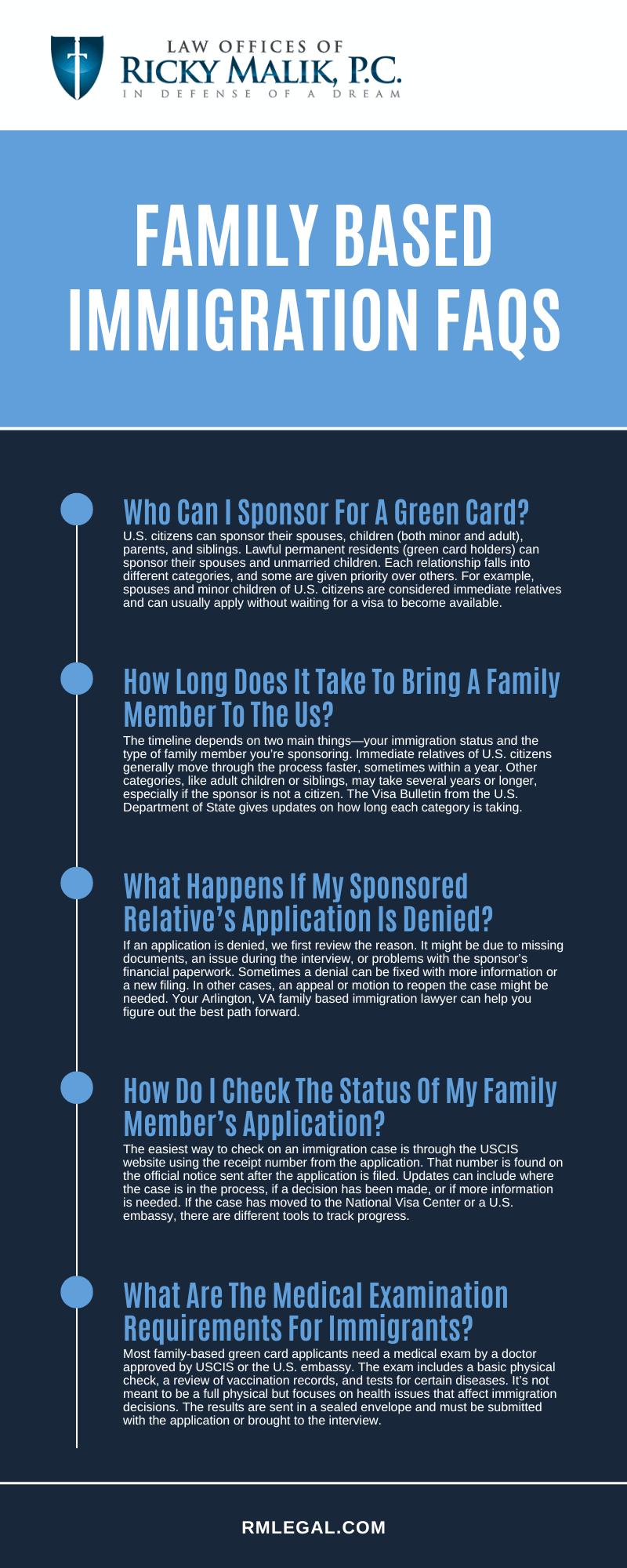
Understanding Family Based Immigration Cases
How Family Petitions Work and What Determines Wait Times
Family-based immigration begins with a petition filed by the sponsoring U.S. citizen or lawful permanent resident. The relationship determines which category the applicant falls into and whether they face a wait for visa availability. Key categories include:
- Immediate relatives of U.S. citizens: not subject to annual caps; no backlog after petition approval
- Family first preference: unmarried adult children of U.S. citizens; subject to annual caps
- Family second preference (2A): spouses and minor children of lawful permanent residents
- Family second preference (2B): unmarried adult children of lawful permanent residents
- Family third preference: married children of U.S. citizens
- Family fourth preference: siblings of adult U.S. citizens; longest typical waits
The Department of State Visa Bulletin tracks priority dates monthly. Applicants from countries with high demand for family-based visas often face longer waits than applicants from other countries, even within the same preference category.
What Are Important Aspects of a Family Based Immigration Case?
Several factors shape how a case moves forward and where problems tend to arise:
- Admissibility issues based on prior unlawful presence, criminal history, fraud, or prior removal orders can block an approved petition from moving forward. Not all of these can be waived, but many can be addressed with proper preparation and a timely filing.
- Documentation of the qualifying relationship must be thorough and consistent. Gaps or inconsistencies in the record are a frequent source of requests for additional evidence and interview delays.
- Changes in circumstance, such as divorce, the death of a petitioner, a child aging out of a preference category, or a change in the petitioner’s own immigration status, can each affect a pending case in different ways.
- Applicants with prior removal orders may need those orders addressed separately before a family-based case can proceed.
What Is the Family Based Immigration Case Timeline?
Timelines vary significantly based on the category and individual circumstances. A general framework:
- I-130 petition filing and USCIS adjudication: currently takes several months depending on the service center
- Priority date wait for preference categories: ranges from months to many years based on category and country of birth
- National Visa Center processing: after USCIS approval, the NVC collects fees and documents before scheduling a consular interview or forwarding the case for adjustment
- Adjustment of status or consular interview and decision: processing times vary by USCIS field office and by the specific consulate involved
Current processing estimates are available on the USCIS processing times page and are worth reviewing before setting expectations for a specific case.
What Should You Bring to Your Family Based Immigration Consultation?
Coming prepared helps us assess your situation accurately from the start. Bring the following:
- Proof of the petitioner’s U.S. citizenship or lawful permanent resident status
- Documentation of the qualifying family relationship: marriage certificate, birth certificate, or other relevant records
- The applicant’s passport and any prior U.S. visa or immigration history
- Records of any prior immigration filings, petitions, visa applications, or removal proceedings
- Documentation of any criminal history on either party’s record
We will review the full picture, identify any complications, and give you a clear sense of what the process will involve for your specific situation.
What Are Important Virginia Legal Resources for Family Based Immigration Cases?
Family-based immigration is governed by federal law. The following are reliable references for anyone beginning this process:
- USCIS family-based immigration — official USCIS overview of petition types, eligibility, and procedures for all family categories
- USCIS I-130 information — filing requirements and processing details for the immigrant petition for alien relatives
- Department of State Visa Bulletin — monthly priority date updates for family preference categories (linked above in the Understanding section)
- USCIS processing times — current estimates by form and service center
- Department of State family immigration — consular processing information for family-based immigrant visas
Reach Out to the Law Offices of Ricky Malik, P.C. to Schedule a Consultation
If you are ready to begin a family-based immigration case, or if a petition is already pending and has run into a complication, the Law Offices of Ricky Malik, P.C. is available to review your situation. We have handled family immigration matters across Virginia, Maryland, and Washington, D.C. for more than 20 years. Contact us to schedule a consultation with an Arlington, VA family based immigration attorney.
Hear From Our Client Community